
When “Nation Branding” becomes a human rights violation
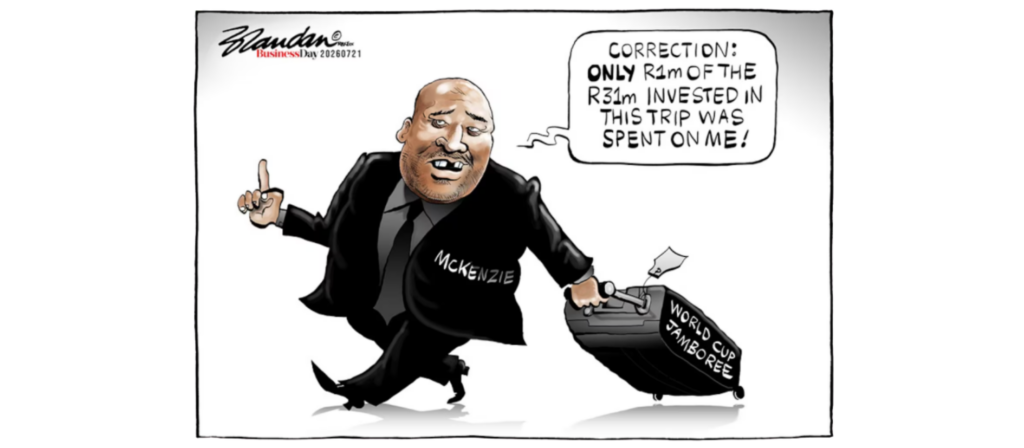
Image Credit: Cartoon | McKenzie’s World Cup junket (Brandan Reynolds) https://www.businessday.co.za/opinion/2026-07-21-cartoon-nothing-to-hide-gayton-mckenzie-splashes-r1m-at-world-cup/
When “Nation Branding” becomes a human rights violation
by Russell Pollitt SJ
In the last week, South Africa’s Sport, Arts and Culture Minister, Gayton McKenzie, disclosed that his department had spent an estimated R31-million of taxpayers’ money on a delegation to the FIFA World Cup, covering international travel, hospitality suites, match tickets, and cultural activities for officials, artists, and invited guests. The amount he splashed out has drawn condemnation from political parties. I want to suggest that this scandal is not merely political—it is a matter of human rights.
Our country is one of the most unequal on earth. Millions of people live without secure housing, reliable water, adequate healthcare, or functioning schools. The infrastructure of our cities crumbles away. Youth unemployment sits at crisis levels, and public sports infrastructure in townships and rural areas is frequently derelict or non-existent.
Against this backdrop, R31-million spent on international travel, luxury accommodation, and hospitality for a ministerial delegation is scandalous. I went online to see how much a business-class ticket to Mexico would cost; the figure was between R90,000 and R120,000—say R200,000 return. That is exorbitant in itself, but the mind boggles at how, even flying business class, you can reach a figure of R31-million. This kind of excess is, to my mind, a direct diversion of resources from the realm of basic rights into the realm of prestige and self-aggrandisement. Some have praised the Minister for being transparent. That, in itself, is settling for the lowest common denominator. We should not praise public officials for doing what is basic to their duty.
International human rights law recognises economic and social rights—to housing, health, water, and an adequate standard of living—as legally significant, not optional aspirations. Our Constitution enshrines these rights explicitly, and obligates the state to take reasonable steps, within available resources, to realise them progressively.
Every rand spent on a minister’s flights and hotel suites—and those of his hangers-on—was, by definition, available, and was chosen not to go toward that constitutional obligation. It could instead have funded community sports fields or youth facilities. This can, therefore, be framed as a human rights argument because resources that could have progressively realised socioeconomic rights were instead spent on excessive living and, according to the Minister, on branding the country. What are we branding the country for when many children lack a daily meal, water, education, and live in squalor?
McKenzie has defended the spending as a strategic investment with economic and cultural returns, and has promised full transparency once a traveller-by-traveller reconciliation is complete. He has a right to defend himself, and we should hear that defence, but one factor cannot be dismissed. A strong return on this kind of spending could plausibly benefit the country through investment, tourism, or exposure, but the burden of proof is high precisely because of what is being weighed against it. Spending taxpayers’ money—not his own—on frills that may or may not bear fruit, against a backdrop of dire deprivation, is not justifiable. There is little to suggest this will attract investment capable of making a real difference in people’s lives. The bottom line: the Minister has spent lavishly while millions live with unmet basic rights enshrined in the Constitution.
None of this negates the importance of sport, national pride, or international engagement. South Africa’s football success on the world stage matters, and government has a legitimate role in supporting it. But legitimacy requires proportionality and transparency. A government that cannot provide its poorest citizens with water, clinics, and classrooms cannot spend tens of millions on delegations to an overseas sports tournament. It is immoral.
The R31-million controversy should be understood not just as a political embarrassment, but as a living witness to whether the South African state is honouring its most basic obligations to its people. It is certainly not. The Minister of Sport, Arts and Culture has affirmed, again, that the government lacks even a hint of conscience for the plight of millions of desperately poor South Africans. This is a human rights violation; don’t be fooled.


